


There was a time when landmark buildings were designed to be seen.
Today, they must also be designed to serve.
Glass towers rise across India, polished, impressive, aspirational. They dominate skylines from financial districts to emerging smart cities. But behind that brilliance lies a critical question:
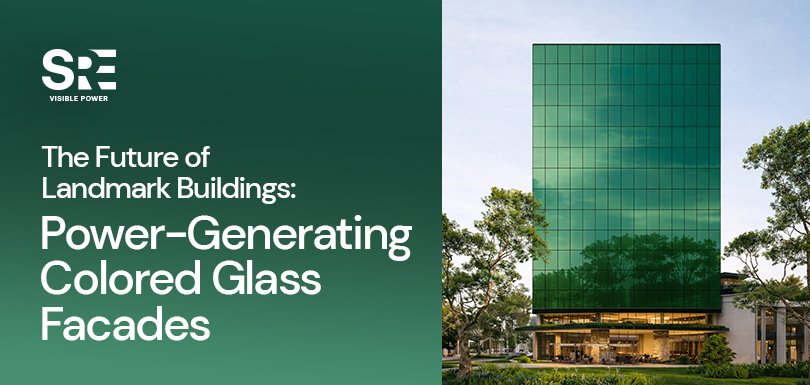
Should a façade only reflect sunlight, or should it convert it into power?
As India’s first manufacturers of photovoltaic glass façades, we believe the future of landmark buildings is not just visual. It is functional. It is measurable. It is intelligent.
From Decorative Skin to Energy Asset
For decades, façades were treated as architectural skin, a surface for identity and aesthetics. The focus was on color, texture, and light play. Performance was secondary.
But energy costs are rising. ESG benchmarks are tightening. Sustainability is no longer a marketing line; it is a business mandate.
We saw an opportunity others overlooked.
What if the largest visible surface of a building, its glass façade, could become its most productive asset?
Photovoltaic colored glass façades do exactly that. They integrate solar technology within architectural glass, allowing buildings to generate electricity without adding bulky rooftop panels or disturbing design intent.
No compromise.
No visual intrusion.
Just architecture that performs.
Why Colored Power-Generating Glass Changes the Game
Let’s address the traditional hesitation around solar integration: aesthetics.
For years, solar panels were considered necessary but unattractive. Functional, yes. Elegant, rarely.
Landmark buildings cannot afford visual compromise. Architects demand freedom. Developers demand ROI. Tenants demand sustainability credentials.
Our colored photovoltaic glass solutions allow custom tones, patterns, and finishes , all while generating measurable energy output. The façade retains its design language. Yet beneath that refined surface lies advanced solar engineering.
This shift aligns seamlessly with sustainability frameworks such as the Indian Green Building Council certification and global green building standards. Energy generation becomes embedded in the building’s DNA, not retrofitted as an afterthought.
Designing for India’s Climate and Ambition
India receives abundant sunlight for most of the year. Yet many commercial buildings still rely entirely on external energy sources.
In a country building at unprecedented speed, we cannot afford passive architecture.
From corporate headquarters to institutional campuses and mixed-use developments, every vertical façade represents untapped potential. By integrating photovoltaic glass at the design stage, landmark buildings can significantly reduce operational energy dependency.
This is not just about environmental responsibility.
It is about strategic foresight.
Lower operational costs.
Improved sustainability ratings.
Enhanced investor confidence.
Stronger ESG positioning.
When a building generates power through its façade, it communicates leadership, not only in design, but in accountability.
Landmark Buildings Must Lead the Transition
Historically, landmark structures have shaped cities’ identities, whether through height, innovation, or symbolism. Today, innovation must extend beyond form.
The future landmark will not compete solely on how dramatic it looks at sunset. It will compete on how efficiently it performs at noon.
It will be judged by:
- Energy output metrics
- Carbon reduction impact
- Long-term operational savings
- Integration of renewable technology
As India’s first photovoltaic glass façade manufacturer, we are not simply producing material. We are redefining what a façade represents.
It is no longer glass alone.
It is Visible Power.
The Future Is Performance-Driven Architecture
The next era of iconic buildings will be intelligent structures, façades that think, generate, and contribute. Architecture will no longer be passive. It will participate.
Developers who embrace this shift today will set tomorrow’s benchmarks. Architects who integrate energy-generating glass into their creative vision will design buildings that are both admired and accountable.
The skyline of the future will still shimmer.
But it will also sustain.
And that is the evolution landmark buildings have been waiting for, not just standing tall, but standing responsible.